

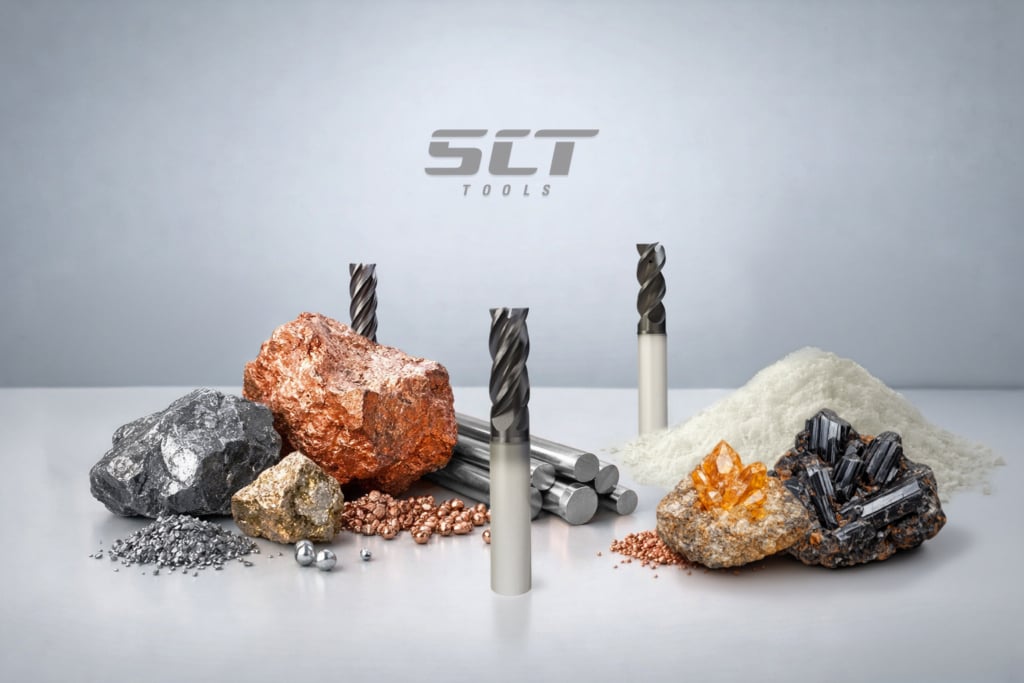
The global carbide industry-essential to modern manufacturing, machining, and high-performance engineering-is entering one of the most challenging periods in its recent history. Carbide tools, often referred to as cemented carbide tools, are the backbone of precision manufacturing. They are indispensable in industries such as automotive, aerospace, energy, defense, medical technology, and general metalworking.
Yet behind their exceptional performance lies a growing vulnerability: an increasing dependence on scarce and geopolitically sensitive raw materials. Over the past few years, and particularly since 2025, the industry has been confronted with unprecedented price increases, supply chain instability, and strategic uncertainty. These developments are not temporary fluctuations-they reflect deeper structural changes that will shape the carbide sector for years to come.
This article explains what is happening, why it matters, and-most importantly-what companies can do to remain competitive in this new reality.
What Is Carbide and Why Are Raw Materials So Critical?
Carbide cutting tools are typically composed of tungsten carbide particles bonded together with cobalt. Tungsten provides extreme hardness and wear resistance, while cobalt acts as a binder that adds toughness and shock resistance. This unique combination allows carbide tools to cut, drill, and mill materials that would quickly destroy conventional High-Speed Steel (HSS) tools.
However, this performance comes at a cost: both tungsten and cobalt are classified as critical raw materials. They are difficult to substitute, energy-intensive to produce, and concentrated in a limited number of geographic regions. As a result, the entire carbide supply chain is highly sensitive to disruptions.
Explosive Raw Material Price Increases Since 2025
The year 2025 marked a turning point for the carbide industry. Prices for essential raw materials surged at levels rarely seen before. According to multiple market sources, tungsten powder prices increased by more than 226% within a single year. Tungsten carbide powder followed a similar trajectory, rising by over 218%, while cobalt prices climbed by more than 200% in the same period.
These increases were not driven by speculation alone. They resulted from a convergence of structural and geopolitical factors:
· Persistent global supply shortages
· Export restrictions imposed by producing countries
· Reduced mining output and declining ore quality
· Strong and growing demand from strategic industries such as defense, aerospace, energy, and high-tech manufacturing
For tool manufacturers and end users alike, this translated into higher tool costs, reduced margins, and increased uncertainty in long-term planning.
Continued Price Pressure in 2026: No Relief in Sight
Hopes that 2026 would bring market stabilization quickly faded. Since January 2026, prices for tungsten-related materials have continued to rise sharply. Ammonium Paratungstate (APT)-a key intermediate product in tungsten production-climbed from approximately USD 1,100 per metric ton unit at the beginning of the year to well over USD 1,800, representing an increase of roughly 60% in just a few months.
Several forces are driving this continued escalation:
· Export restrictions from China, including licensing requirements and limits on the number of authorized exporters
· Reduced mining quotas and increasing extraction difficulty
· Rising domestic demand within producing countries
· Strategic stockpiling by governments and large industrial players
Together, these factors ensure that price volatility remains high and supply tight.
Dependence on China: A Structural Vulnerability
One of the most critical issues facing the carbide industry is its heavy reliance on China. China dominates the global production and processing of tungsten and plays a significant role in cobalt refining. Europe, in particular, remains highly dependent on Chinese imports for critical raw materials.
Developing alternative sources is far from simple. New mining projects in Europe or other Western regions face long permitting processes, high environmental standards, and major capital requirements. From initial exploration to full-scale production, a new mine can take 15 to 20 years to become operational-far too slow to address current shortages.
Recycling, while promising, is not yet a complete solution. For many critical raw materials, current recycling rates remain between 1% and 5%, and some materials are barely recycled at all. This leaves the industry exposed to external shocks and political decisions beyond its control.
Alternative Sources: Necessary but Long-Term
Efforts to diversify supply chains are underway. Governments and industry groups are investing in alternative tungsten and cobalt sources in regions such as South Korea, Vietnam, Kazakhstan,
Tajikistan, Canada, and the United Kingdom. These initiatives are strategically important, but they are inherently long-term solutions.
Mining infrastructure, logistics, environmental compliance, and skilled labor all take time to develop. As a result, the carbide industry must accept that supply constraints and elevated prices are likely to persist for the foreseeable future.
Strategic Responses for Carbide Tool Manufacturers and Users
In this challenging environment, companies cannot afford a passive approach. We can outline several strategic measures that, when combined, can significantly mitigate risk and cost pressure.
- Building Strategic Inventories
Holding larger inventories of raw materials or finished tools can act as a buffer against sudden supply disruptions and price spikes. While this ties up capital, it provides operational security in a volatile market.
- Application-Specific Tooling
General-purpose tools offer flexibility, but they are not always the most efficient option. Application-specific tools are designed for a particular operation or material and often deliver significantly longer tool life, higher process stability, and lower cost per part.
- Combined and Multi-Function Tools
Special carbide tools that perform multiple machining operations in a single cycle reduce overall tool consumption and simplify tool management. Fewer tools mean lower inventory levels, reduced setup times, and improved production efficiency.
- Smart Use of Alternatives
Carbide is not always the optimal solution. Indexable insert tools can replace large solid carbide tools in many applications, especially at long overhangs. High-speed steel (HSS) remains suitable for simpler operations, while materials such as cermet, CBN, and PCD can outperform carbide in specific use cases.
- Regrinding and Tool Life Extension
Regrinding worn tools extends their usable life and reduces the demand for new raw materials. Multiple regrinding cycles can significantly lower tooling costs while improving sustainability.
- Recycling Within Europe
Collecting and recycling worn or broken carbide tools ensures that valuable tungsten and cobalt remain within the European supply chain. Local recycling reduces dependence on primary raw materials, strengthens supply security, and supports the transition toward a circular economy.
Conclusion: Adapting to a New Reality
The carbide industry is undergoing a structural transformation. The dramatic price increases of 2025 and continued pressure in 2026 are not temporary anomalies-they are symptoms of deeper shifts in global supply, geopolitics, and industrial demand.
While alternative raw material sources and recycling initiatives will play a growing role in the future, they cannot provide immediate relief. In the meantime, success will depend on strategic foresight, technical optimization, and disciplined resource management.
Companies that proactively adapt-by optimizing tooling strategies, extending tool life, diversifying materials, and investing in recycling-will be best positioned to navigate this turbulent period. Those that fail to respond risk losing competitiveness in an industry where material efficiency and supply security are becoming as important as cutting performance itself